


Born in Hampshire, Raised in Celebration: establishing an English vineyard
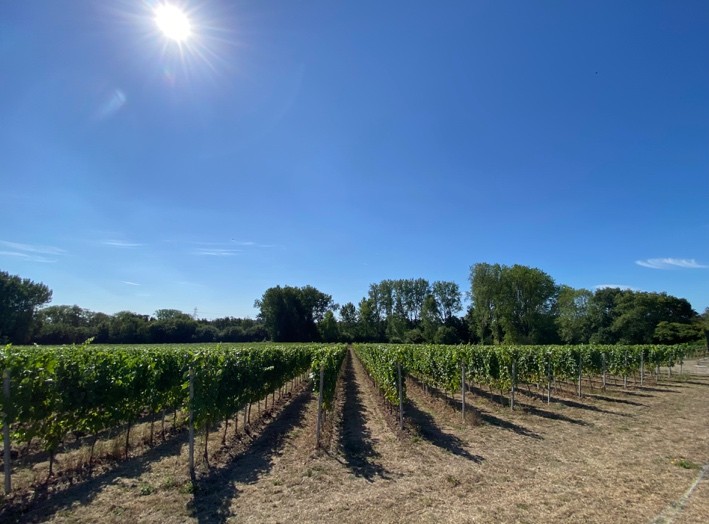
In 2019, Nick and Mary Hill purchased a beautiful south-facing plot of land on the Blackwater River ford at West Wellow in Hampshire.
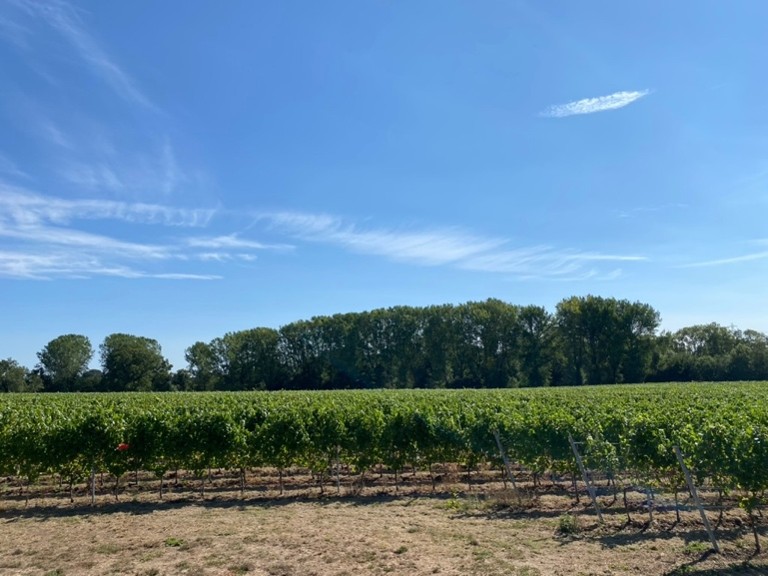
Resting in the peaceful Test Valley, surrounded by rolling hills, woods and fields, their site is now home to Foxford, a two-hectare, 8,500 vine vineyard, planted in 2020. On a bedrock of sandstone, the soil is a deep, free-draining sandy loam, ideal for viticulture.
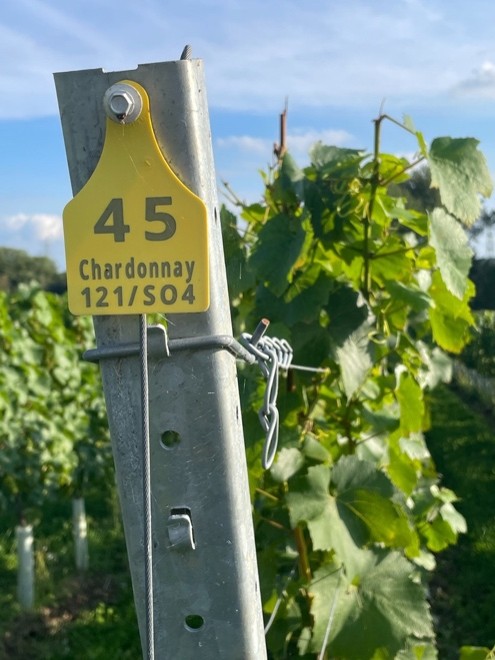
They grow Chardonnay, Pinot Meunier and Pinot Noir, collectively known as the classic traditional method sparkling trio.
They run the vineyard with a personal touch. Much of the hard work is done themselves; you will often find them at the vineyard in all weathers pruning or tying down, leaf stripping and tucking in. At harvest, they select and hand-pick every bunch with a group of local pickers to ensure exceptional quality.
Why did you decide to establish a vineyard?
Both of us have pursued successful professional careers, mostly office based, but as time went on, we began to be drawn back to the idea of working outside, a return to nature and the outdoors which has been a parallel passion for both of us. There is something very exciting about a more deterministic environment: being driven by the elements, confronting the challenges of the weather, immersing oneself in the seasons. This is very different to our previous careers and yet very in line with personal values and priorities. However, with our business hats on, it was also attractive to be launching a business into a growth market that has an increasingly professional reputation and a progressively more appealing profile with the British consumer and beyond. There are now over 1,100 vineyards in England and Wales and 240 wineries producing 10.7m bottles per annum. Not to mention the prospect of producing some excellent wines!
With this in mind, Nick began a two-year diploma course at Plumpton College in East Sussex, widely regarded as the pre-eminent college for all wine-related study. This provided an excellent foundation for our viticulture journey, and we began to look for a suitable site to purchase for our vineyard.
What were you looking for in a potential vineyard site?
We had a raft of criteria to consider when looking for our site. The common photograph-inspired perception of vineyards is of sun-soaked terraces in the Rhone valley or swathes of prestigious Bordeaux real estate with imposing chateaux towering in the distance. Looking for an English winegrowing site is not so obviously seductive and presented a set of somewhat complex equations to solve for. Climate, weather, site topography, soil and other components (typically known as the terroir) all interact in an intricate set of related dynamics, meaning the viticulturalist has a lot to consider when compiling their checklist.
Primarily the English weather is the first challenge to overcome and is one of the main differences in vineyard management between English vineyards and those in the more traditional warmer climate areas of the world. Sites need to be sheltered from the wind, but not to the extent that freezing air cannot drain away, or diseases form in the summer because the air is too still. They need to ideally possess a microclimate that offers optimum rainfall and maximum sunshine hours. And growing temperature (often measured as growing degree days or GDD) is of course one of the most important features, making the southern English counties the most obvious starting point for a land search. Traditionally, wine makers consider grapes grown in climates between latitudes of 30° and 50° to be the best, but of course global warming is changing this assumption somewhat and some excellent wines are being produced outside these latitudinal guidelines (Foxford is at 50.9°!).
Often mediating climate and temperature, the site itself must have certain topographical features; ideally the land should have a southern, south-easterly or south westerly facing slope. This enables the grapes to catch as much sun as they can in the spring and summer months, and also gives the vine canopy the opportunity to dry quickly after rainfall to prevent mildew and other disease. The slope also allows the movement of cold air downhill to protect against frost damage and gives some gravitational input to allow soil drainage. Altitude is another key issue; it can be challenging to ripen grapes above 100m in England.
And the soil is of course fundamentally important to growing. Free drainage is essential, meaning that one is looking for a friable, crumbly soil that is not full of clay. “Vines don’t like wet feet” is a common saying among growers and keeping vine roots dry and unsaturated is a must. The best vines have roots that are constantly in search of water, delving down as far as they can to pick up both water and minerality from underlying soils and rock. A misconception might be that the vineyard needs soils highly rich in nutrients, and of course a healthy soil is good, but one needs to make vines work hard for their food and overly nutrient rich soils are not so desirable. Vines are incredibly resilient and will search out what they need.
Given all the interrelated aspects of terroir, you might imagine it took us a little while to find the right site. We were open-minded about where this might be. Anywhere in the southern counties would have been a pragmatic option for us. We undertook the search ourselves; we figured that we potentially knew as much as anyone about what we were searching for.
And within 6 months we found our beautiful five-hectare plot in West Wellow, Hampshire. The site was an arable farming plot, set just above a Test River tributary, surrounded by trees and other multiple use agricultural land. It ticked many, if not all, our wish list boxes. The site has frost protection from its proximity to water (water bodies keep the soil warmer) and is sheltered from prevailing winds. The soil is a lovely sandy loam, with excellent drainage, and the south south-westerly facing slopes allow excellent all-day sunshine.
Now the difficult bit – how do you start a vineyard from scratch?
Right from the start we knew we wanted to focus on English Sparkling Wine (but retain the option to produce still wine in good growing seasons). Partly this was because we thought the quality of existing English Sparkling Wines was excellent, the market was exciting, and also because traditional method sparkling wines are a big part of our time with family and friends whenever we have an occasion to celebrate. And so in May 2020 we planted 8,500 vines on half our site in 73 rows of metre-spaced plants. The vines are Burgundy clones of the three traditional varieties: Chardonnay, Pinot Noir and Pinot Meunier, and they sit within a system of trellising posts and wires designed to deliver maximum sunlight to the canopy and ventilation around the fruit.
The vines are about 30cms tall when planted (20 cm above ground and 10cm of roots) and need a lot of protection from various wildlife; we attached 8,500 rabbit guards and invested in around a kilometre of deer fencing in the hope that we’d hang on to our precious vines long enough to allow them to become well established. (The rabbit guards come off after about two years, but deer are a constant threat, and the deer fencing is vitally important).
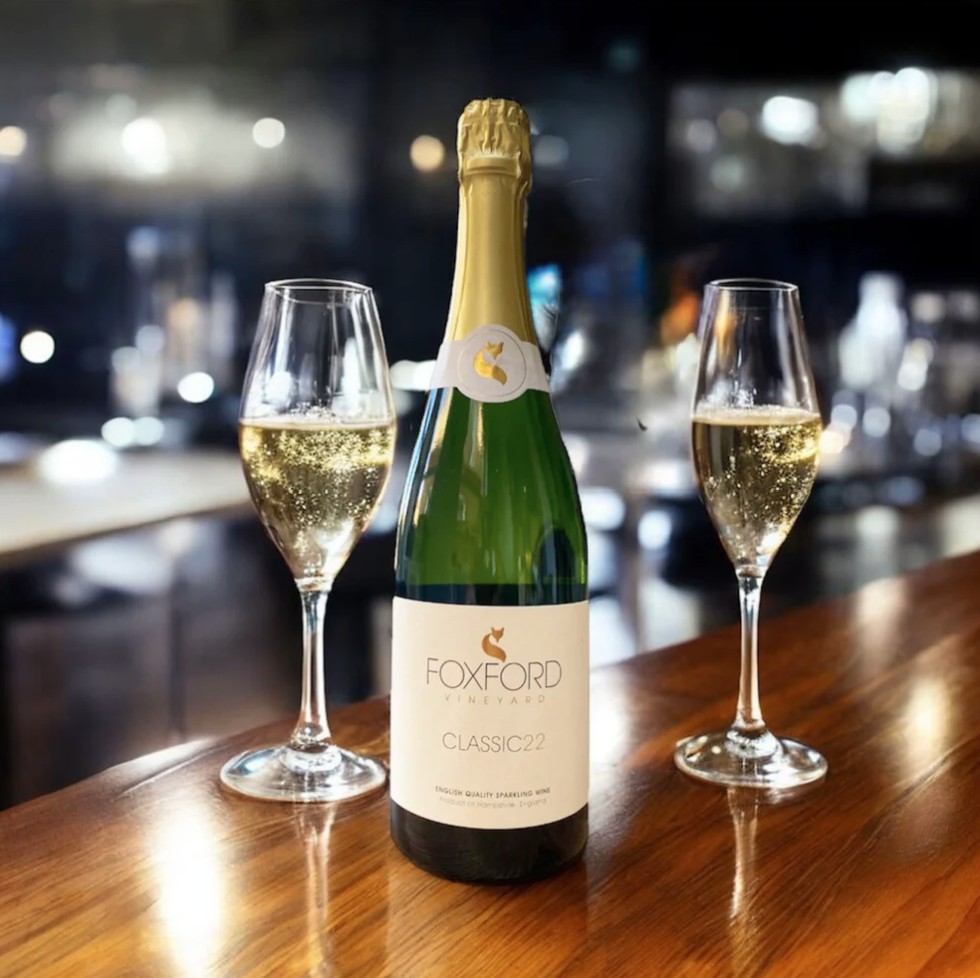
Thus began our growing journey. Vines take typically three growing seasons before they provide a harvest, and so our first grapes were harvested in autumn 2022. The first harvest is usually a small one – and Foxford was no exception, but the upside of such a small harvest is that the grapes are crammed full of concentrated flavours. We’ll talk about making the wine in more detail later, but our 2022 harvest resulted in 2,500 bottles of our well received first Foxford vintage Cuvée, ready to drink in the autumn of 2025.
The vines are about 30cms tall when planted (20 cm above ground and 10cm of roots) and need a lot of protection from various wildlife; we attached 8,500 rabbit guards and invested in around a kilometre of deer fencing in the hope that we’d hang on to our precious vines long enough to allow them to become well established. (The rabbit guards come off after about two years, but deer are a constant threat, and the deer fencing is vitally important).
Thus began our growing journey. Vines take typically three growing seasons before they provide a harvest, and so our first grapes were harvested in autumn 2022. The first harvest is usually a small one – and Foxford was no exception, but the upside of such a small harvest is that the grapes are crammed full of concentrated flavours. We’ll talk about making the wine in more detail later, but our 2022 harvest resulted in 2,500 bottles of our well received first Foxford vintage Cuvée, ready to drink in the autumn of 2025.
Can you give us an idea of a season in the vineyard?
During the winter the vines are completely dormant. There are still some jobs, however, that are really important for the coming year as they set the vines up for the best possible growing conditions and yield. From December to March, you will find teams of people pruning the old growth from the vines and choosing the canes that will carry grapes for the new season. The old canes need pulling out, and the chosen canes need tying down on the wires. This is intensive work along 8.5km of vines; we do a lot of it ourselves and also have some help from local teams of experienced viticulture experts.
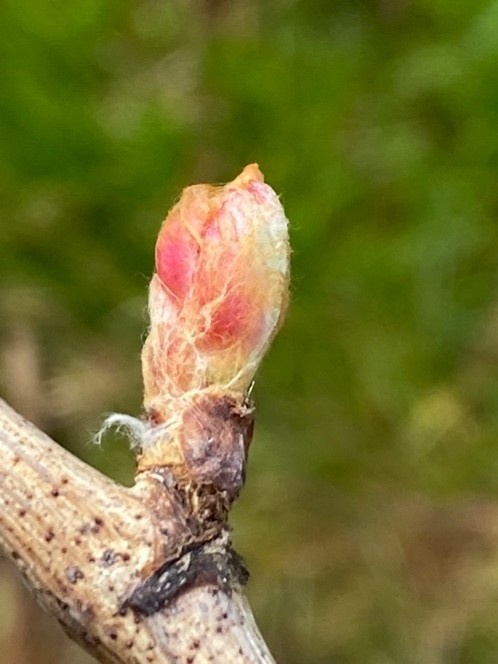
As March progresses, so the growing season commences, sap rises and woolly buds emerge anytime during late March and April. When the buds begin to open, we call this bud burst, and this is the highest risk period in the vineyard. If there is a frost in late April or early May, this can decimate the potential harvest as it kills the emergent buds. Whilst other buds may subsequently emerge, they are not as vigorous as the original growth and will not give the quality of grapes desired. Many vineyards invest heavily in frost protection measures, which are both hugely expensive and also somewhat unreliable in terms of their efficacy. At Foxford we have chosen to leave things to nature – but this doesn’t stop us being awake at 4am on some May mornings, watching the data feed from our weather stations and praying to the Gods that all will be well!
From May to June, we start to see the foliage emerge and the canopy growth starts in earnest. With the right conditions, vine canopies grow vigorously and need a lot of trellis and wire management. Canopy management is extremely important to minimise disease and maximise photosynthesis. We prefer cultural practices such as leaf stripping (first on the east side, then the west, to ensure air circulation and ripening opportunity), canopy trimming and wire-tucking, rather than being over-reliant on spraying interventions.
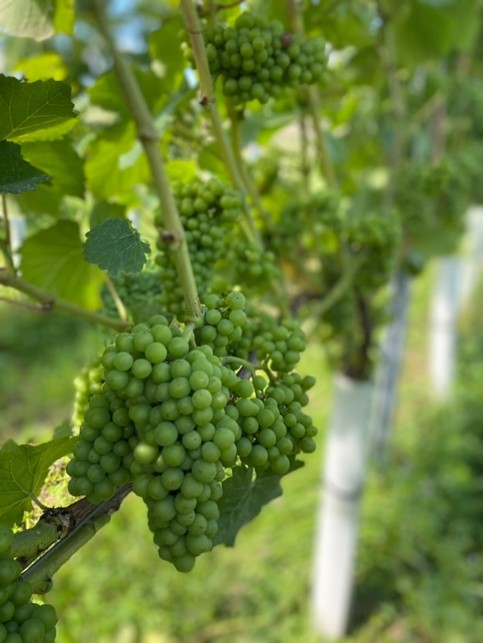
In early June, the vines produce little self-pollinating flowers in tiny bunches, not very noticeable, but hugely important because each bloom becomes a grape – and by late June there is berry formation and the vines are full of small bunches of pea-sized green fruit. During July, green harvest may take place, when grape bunches will be picked and discarded to make sure that the remaining grapes have the space and nutrient resources to reach their peak later in the year.
An important stage in grape-growing is “veraison” when red grapes begin to become darker towards their final colour, and white grapes soften and become more translucent. This happens usually early to mid-August. It gives us a broad idea of harvest time as each vineyard will know the length of time between veraison and picking (in our case usually around two months). Yield and harvest forecasting will commence around this time.
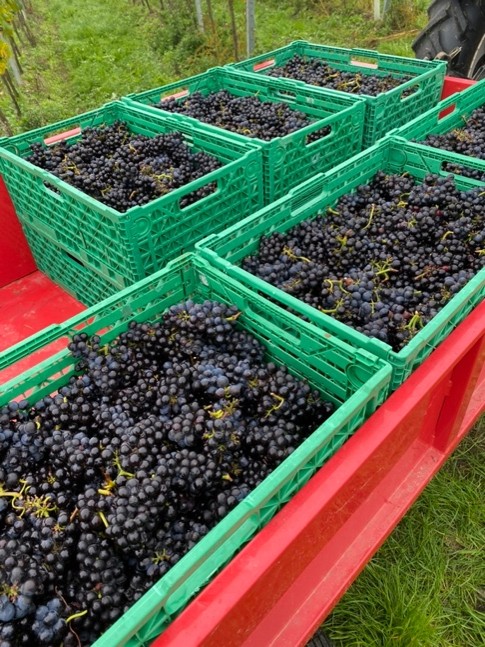
In September, anticipation rises as the grape bunches begin to look like the finished ripened article. Sugars and acids in the grapes will be monitored closely, to see how things are progressing towards the perfect time to harvest. At some point during very late September or October, the measurements will be perfect, and the harvest begins. Harvest days are long, physically hard work, both chaotic and well-organised at once, stressful but hugely satisfying at the same time. It is difficult to describe to anyone who has not been present on a vineyard harvest day quite what the experience is like. It is the culmination of many months’ work and represents the birth of a new wine, exhausting but hugely exciting.
As the grapes are driven off to the winery, the vineyard returns slowly to its dormant phase, leaves fall and the vines settle down for the winter.
How is climate change influencing viticulture in England?
A potential misconception is that climate warming can only be a good thing for English vineyards. And the propensity of French champagne houses to buy up land in the south of England to safeguard their climate risk adds clout to this view. There is no doubt that the climate is warming and the headline effect of this is that berries in England tend to experience more effective sun hours than was the case several years ago. However, the position is more complicated when you consider other issues. Temperatures may be higher but weather also seems more random. If higher temperatures encourage earlier bud burst, the risk of damage through frost through frost is enhanced and some vineyards have experienced catastrophic loss in recent late frost years. Extreme weather events such as hail later in the year can also leave a harvest decimated. And extended high summer temperatures raise sugars and alcohol content to the extent that balancing sugars and acids well can become more difficult. The conclusion? The picture is generally positive but intricately complex and grape quality will often depend on the particular features of each vineyard and how they are managed, rather than the broad climate effects of global warming.
So the grapes are successfully harvested – how do you make your wine?
Our wine is made at a winery up the road. Our wines are traditional method sparkling wines and this means they need careful blending, a double fermentation and a long period of ageing before they are ready. The primary fermentation occurs in the tank over a period of a few weeks and the wine then ages in tanks and oak barrels (oak is used for its particular flavour characteristics). We blend the base wine from the different grapes and containers the following spring, and further ageing occurs before the wine is bottled in the May post-harvest. At bottling, yeast and sugar are added to create the second fermentation in the bottle. The wine remains in the bottle for a significant period (we typically leave it two years or more) during which it is “on lees” and is acquiring its own nose, palate and autolytic character. Thus, around three years after harvest, our Cuvée is ready to drink. Our first Cuvée (Foxford22) has been very well received and won a silver medal at the recent Wessex WineGB awards and we have also won a silver medal at the prestigious IWSC awards, plus a few others! We are keenly anticipating our 2023 wines, another traditional method Classic Cuvée which will be drinking in the autumn of 2026, and a Blanc de Blancs (100% Chardonnay) which we anticipate lees-aging for at least three years. In further years, from our 2024 and 2025 harvests we shall have a sparkling Rosé, and other classic cuvees from each year. It is too early to forecast 2026 – but we hope to build on this success with another outstanding English quality Sparkling wine.
Who is your target client?
We are a small family-owned business, and as such our volumes are modest but high quality and each wine is expertly blended and crafted. All our fruit comes from our own vineyard. We are not a volume producer, and this influences how we bring our product to market. The person that drinks Foxford will be an individual who appreciates the unique aspects of English Sparkling wine. This tends to be someone who prefers an aromatic and dry (or very dry) wine with a fresh nose (green and citrus) and crisp, clean and elegant fruit on the palate with a hint of toastiness. It will also be someone who enjoys drinking a wine from a local vineyard that can compete with the best sparkling wine on the market.
What do you wish you’d known at the outset?
Of course much of the theory of grape-growing was familiar, but there are always things along the way in practise that are a surprise! Issues ranging from how appetising wasps and birds find grapes, how very quickly certain weeds grow, and how almost impassably muddy a vineyard gets in the winter are all examples of needing to think quickly on our feet.
In broader terms, however, an important issue for any wine producer at the moment is the state of the hospitality market, and this is something that we need to work hard at right now. Pubs, bars and restaurants are struggling hugely, driven by many issues: unsympathetic budget measures, lack of cash in people’s pockets, rent and rates charges, costs of employment. This often means that restaurant and bar owners feel very restrained on the quality and price of what they can stock. Wine producers must have flexibility and creativity in making their product attractive in a very difficult market. We hope the government recognises that some support for the hospitality sector is long overdue.
The other area we think needs some attention is the relationship English Sparkling Wine has with the public. First, this is about education, so that the market understands the differences between a traditional Champenoise method (English Quality Sparkling Wine and French Champagne, for example) versus tank method production (Prosecco and other Charmat products). This will help retail purchasers distinguish between products and understand the different pricing of wines, so that there is less of a constant pressure to justify pricing.
And finally, this links into branding for the English market as a whole; the name English Quality Sparkling Wine does not roll off the tongue as does Champagne or Cava for example. Until we all find a moderately more attractive name, it will continue to be cumbersome to refer to the product and market it smoothly. Something for everyone to think about.
What is next for Foxford?
We are establishing the Foxford brand as a premium aspirational English label and will have this as our main target. We’ll continue our push to be listed in a range of high-quality establishments through southern England and are also talking to interested distributors abroad. We are developing a strong local community following and have noticed how loyal local customers can be when they feel as though they know you well. We will carry on increasing our number and styles of wine each production year in order to offer customers many different ways to experience Foxford. In short, we intend to push forward on this remarkable journey, but we are of course still learning about how to be better.
Along the way they have learnt much, not all of it consistent with the contents of viticulture textbooks! Here, they answer some questions about their motivations, their experiences, and what has (or not) gone to plan on their journey.
If you are interested in sampling Foxford, we’ve included our website address at the bottom of this article. There is also a discount code if you would like to make a purchase at 10% discount. You are welcome to leave your email address via the website for updates on our releases and vineyard events that we run throughout the year. You can also follow us on Instagram.
Discount code: COUNTRYHOUSE10